International Standard Bibliographic Description (ISBD)
Tien Ngo
March 16th, 2026
12 mins read
ISBD (International Standard Bibliographic Description) is a set of rules that governs the order, elements, and punctuation used in describing documents, helping standardize cataloging and global data exchange.
The ISBD standard operates on the principle of dividing data into areas in order to optimize information recognition. One of ISBD’s greatest achievements is the establishment of a highly standardized system of punctuation marks, enabling computers to parse data automatically and accurately.
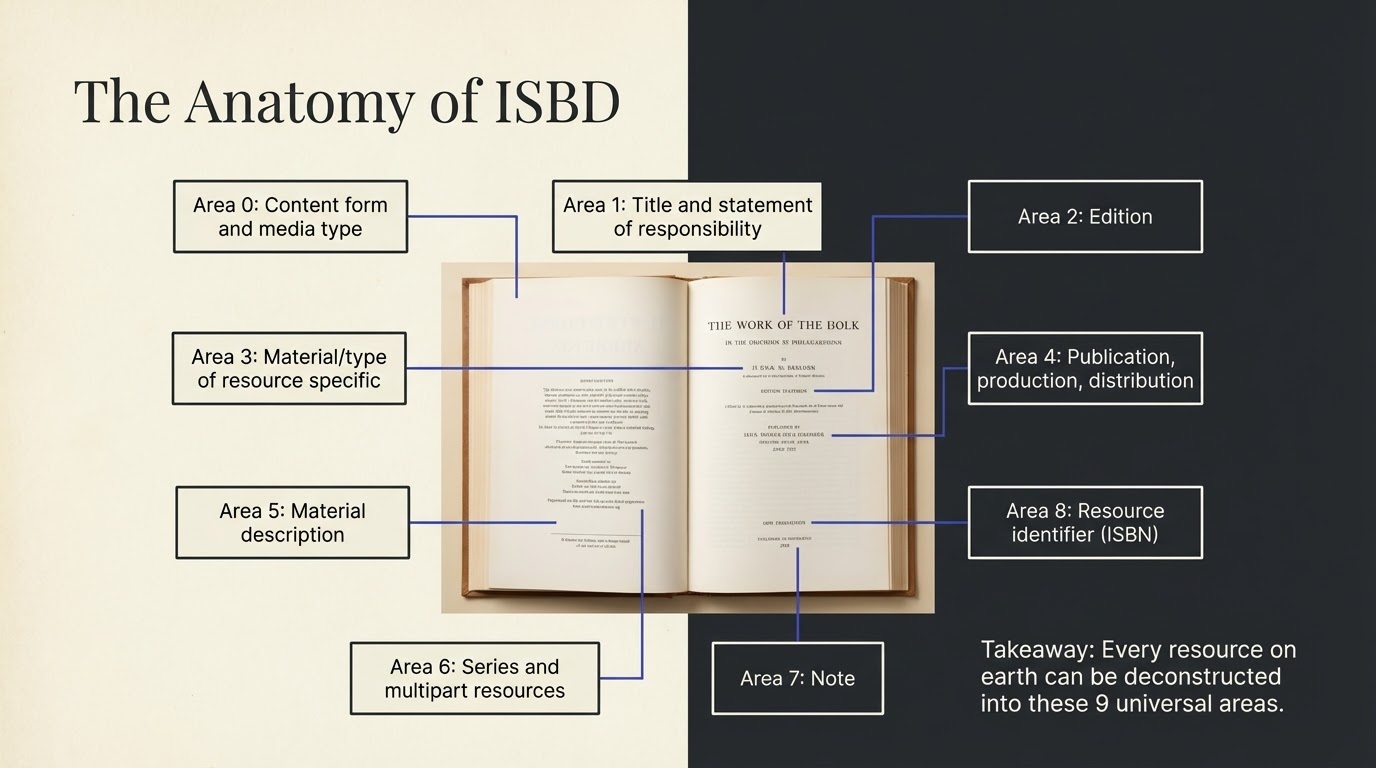
1. Structure of the description areas and the data separation mechanism
The ISBD system divides the information of a publication into 8 main descriptive areas, each serving a distinct identification function. This arrangement is not random, but follows the natural logic of search and recognition used by readers.
| Description area | Key data elements |
| Area 1 — Title and statement of responsibility | Main title, parallel title, information about the author, editor, etc. |
| Area 2 — Edition | Information on reprints, revised editions, and responsibility related to the edition. |
| Area 3 — Material-specific details | Used for cartographic materials (scale), serials (volume/issue numbering). |
| Area 4 — Publication, distribution, etc. | Place of publication, publisher’s name, date of publication. |
| Area 5 — Physical description | Number of pages, leaves, illustrations, physical dimensions of the item. |
| Area 6 — Series | Series title, series numbering (ISSN of the series if any). |
| Area 7 — Notes | Notes on content, history of the document, and characteristics that cannot be described in other areas. |
| Area 8 — Resource identifier and terms of availability | ISBN, binding type, price, or terms of availability. |
2. The distinctive punctuation system in ISBD
ISBD establishes a strict order of punctuation marks, where each symbol carries a specific technical meaning. Spacing before and after the punctuation is prescribed to ensure consistency in both display and data processing.
Important rules include the use of the punctuation sequence space, period, space, dash, space (. – ) to separate the descriptive areas. Within Area 1, the equals sign (=) is used for a parallel title, while the slash (/) signals the beginning of the statement of responsibility.
2.1 General punctuation rules
| Punctuation | Function |
| = (equals sign) | Placed before a parallel title (title in another language) |
| : (colon) | Introduces other title information; separates place of publication and publisher; precedes illustrative matter |
| / (slash) | Separates the title from the statement of responsibility (author, translator, etc.) |
| ; (semicolon) | Separates additional statements of responsibility; dimensions; numbering within a series |
| , (comma) | Separates year or listed elements |
| + (plus sign) | Accompanying material |
| ( ) (parentheses) | Encloses series information |
| [ ] (square brackets) | Encloses information supplied by the cataloger from outside the prescribed source |
| ... (ellipsis) | Indicates omission of information (title or statement of responsibility that is too long) |
| . – (period dash) | Separates descriptive areas |
Sequence separating the areas:
Area 1. – Area 2. – Area 3. – Area 4. – Area 5. – Area 6. – Area 7. – Area 8
2.2 Specific rules for each data area in ISBD
Area 1 — Title and statement of responsibility
General format: Main title = parallel title : other title information / statement of responsibility
Example: Lịch sử Việt Nam = History of Vietnam : general textbook / Nguyễn Văn A, Trần Thị B
Area 2 — Edition
General format: Edition statement / statement of responsibility relating to the edition
Example: 2nd edition / revised by …
Area 3 — Material-specific details
This area applies only to certain types of materials, such as maps, printed music, and some other special resources.
Example: Scale 1:25 000
Area 4 — Publication, distribution, etc.
General format: Place of publication : publisher, year of publication
Example: Hanoi : Education Publishing House of Vietnam, 2024
Area 5 — Physical description
General format: Extent : other physical details ; dimensions + accompanying material
Example: 350 pages : color illustrations ; 24 cm
Area 6 — Series
General format: (Series title / statement of responsibility ; series numbering)
Distinctive punctuation: The entire area is usually enclosed in parentheses ( ).
Example: (Social Sciences Series ; vol. 12)
Area 7 — Notes
General format: Note 1. Note 2. Note 3
Area 7 is more flexible than the others; within notes, IFLA recommends that if a resource is described again in a note, the standard punctuation of Areas 1–6 may still be used.
Example: For ages 8–12
Area 8 — Standard identifier and terms of availability
General format: ISBN (note) : price
or ISSN / other identifier / terms of availability
Example: ISBN 9786040123456 (paperback) : 150,000 VND
Full combined pattern
Main title = parallel title : subtitle / statement of responsibility. – Edition. – Material-specific details. – Place of publication : publisher, year of publication. – Physical description : other physical details ; dimensions + accompanying material. – (Series). – Notes. – ISBN/ISSN : price
3. ISBD and MARC
ISBD and MARC can be used independently or together. A MARC record may apply ISBD punctuation rules.
3.1 Correspondence between ISBD areas and MARC21 fields
The conversion from an ISBD record into the MARC21 format is a technical process that requires high precision. Each ISBD area maps to one or more specific MARC21 fields.
| ISBD Area | Corresponding MARC21 fields |
| Area 1 | 245 (Title Statement): $a (Title), $b (Other title information), $c (Statement of responsibility) |
| Area 2 | 250 (Edition Statement): $a (Edition statement) |
| Area 3 | 255 (Cartographic Mathematical Data): $a (Scale), $c (Coordinates) |
| Area 4 | 260/264 (Publication): $a (Place of publication), $b (Publisher), $c (Date) |
| Area 5 | 300 (Physical Description): $a (Extent), $b (Illustrations), $c (Dimensions) |
| Area 6 | 490 (Series Statement): $a (Series title), $v (Numbering) |
| Area 7 | 5XX (Note Fields): 500 (General note), 520 (Summary) |
| Area 8 | 020 (ISBN): $a (ISBN), $c (Price) |
3.2 Differences between ISBD and MARC
ISBD = rules for bibliographic description and presentation
MARC = a machine-readable format for storing and exchanging bibliographic data
Example 1
For the same book Dế mèn phiêu lưu ký, the ISBD and MARC presentations are as follows:
ISBD:
Dế mèn phiêu lưu ký / Tô Hoài. – Hà Nội : Kim Đồng, 2020. – 156 p. ; 21 cm.
MARC21:
245 $a Dế mèn phiêu lưu ký / $c Tô Hoài
264 #1 $a Hà Nội : $b Kim Đồng, $c 2020
300 $a 156 p. ; $c 21 cm
Example 2
A cartographic resource with all 8 ISBD areas and the corresponding MARC fields:
ISBD:
Bản đồ du lịch Đà Nẵng = Da Nang tourist map : for international tourists / Da Nang Department of Tourism. – 3rd edition. – Scale 1:25 000. – Da Nang : Da Nang Publishing House, 2025. – 1 map : color ; 60 x 90 cm, folded to 20 x 10 cm. – (Central Vietnam Tourism ; no. 5). – Includes legend, bilingual Vietnamese-English place names. – ISBN 9786049988888 : 45,000 VND
MARC21:
245 10$aBản đồ du lịch Đà Nẵng = $bDa Nang tourist map : for international tourists /$cDa Nang Department of Tourism.
250 ##$a3rd edition.
255 ##$aScale 1:25 000.
264 #1$aDa Nang :$bDa Nang Publishing House,$c2025.
300 ##$a1 map :$bcolor ;$c60 x 90 cm, folded to 20 x 10 cm.
490 1#$aCentral Vietnam Tourism ;$v no. 5
500 ##$aIncludes legend, bilingual Vietnamese-English place names.
020 ##$a9786049988888$c45,000 VND
Example 3
A MARC record for the book Sapiens from a university library that uses ISBD punctuation rules:
Leader 00000nam a2200241 4500
001 000135952
003 20642
005 20231205141804.0
008 161017s2022 viesd
020 ##$a9786043400502$c259000
040 0#$aLSP$cLSP$dLSP
041 1#$avie$heng
082 14$a909$bHA-Y
100 1#$aHarari, Yuval Noah
245 10$aSapiens :$bA Brief History of Humankind /$cYuval Noah Harari ; translated by Nguyễn Thủy Chung ; edited by Võ Minh Tuấn.
250 ##$aRevised reprint
260 ##$aHà Nội :$bTri thức,$c2022.
300 ##$a566 p. :$bill. ;$c24 cm.
490 0#$aHistory - Religion Series
500 ##$aOriginal English title: Sapiens: A Brief History of Humankind
520 ##$aPresents the entire history of humankind, from its evolutionary roots to the age of capitalism and genetic engineering; with special focus on the major processes that shaped humanity and the world: from the Cognitive Revolution and the Agricultural Revolution to the unification of humankind and the Scientific Revolution
650 14$aWorld history
650 14$aWorld civilization
653 ##$aHumankind
700 1#$aNguyễn Thủy Chung$etranslator
700 1#$aVõ Minh Tuấn$eeditor
852 ##$aLREL$bSecond-floor reading room$jHistory